Grandma’s Mangos

DSCN3014Cutting up mangos is a pain in the neck. Everyone knows that. It’s not a particularly graceful endeavor. If you want them to come out looking like something even remotely edible, you really have to put some time into it. And even then you’re not guaranteed success.

My Cuban grandmother had perfected the art. I remember sitting atop a barstool in our kitchen, elbows digging into the cream-colored tile countertops, my tiny hands propping up my eager face as I observed her every move.

I would watch her strong hands expertly maneuver the knife, creating a smooth line from the top of the mango straight down to the bottom. She would methodically rotate it around and around, gutting the fruit, as bright orange-colored juice gently dripped from the freshly made incisions. Carefully freeing the fruit from the grip of the seed that bore it, one wedge at a time, she eventually exposed the giant pit inside. Then, her thumb lightly pressed atop the peel, she would glide the knife down, removing the speckled skin from each perfect slice.

I can still see her handing the giant pit –dripping with stringy, sweet fruit– across the tile countertop, so that I could bite off whatever was left. I’d lean over the sink and gnaw at it until the strings were stuck in my teeth and all of the good parts were gone.

Just once, when I was old enough, my grandma took the time to teach me her ways- no doubt hoping to pass on the skill of this elusive art form to her only grandchild.

Every now and again, equipped with this knowledge and a decent amount of time having passed since my last attempt, I’ll spot a good-looking mango at the store and my nostalgia gets the best of me. Occasionally the nostalgia wears off before I can get a knife into the darn thing and the mango rots in the fridge. But today, with a little extra time on my hands, I am feeling ambitious.

I start out strong, gutting the mango, just the way my grandmother taught me. I look down at my hands and I can see hers, carefully guiding each incision. But when I reach the halfway mark, I flip it over only to find that I managed to squeeze the other half of the fruit into a mangled mess.

Looking down at the pathetic scene in front of me, I imagine that my grandmother would be disappointed. I’d like to ask her where I went wrong and how in the world you are supposed to keep the other half from turning to mush in your hands. But my grandma has been gone for two years now. Even if she were still here, she had Alzheimer’s disease and I’ll be damned if the particulars of mango slicing are something that would have stuck around.

In some ways, Alzheimer’s is a bit like cutting up a mango. It takes something beautiful, colorful and full, and slowly starts to peel away at it. Some parts get bungled up, bruised, thrown out and forgotten along the way. And then at the very end, it slowly sucks all of the good parts away until all that’s left is the core with a few small shredded pieces clinging on until the bitter end. It’s not a particularly graceful endeavor.

When my grandma was in her final months, she always used to ask me two things: “Estás casadas?” (Are you married?) and “Tienes niños?” (Do you have kids?). When I would shake my head “no” to both of those inquires, she would raise her eyebrows, purse her lips, shrug her shoulders and roll her eyes away from me, as if to say “well then, I’m not sure who you are, but you certainly are of no use to me.” This was okay though, because I know that my grandma –my whole mango grandma– loved me completely.

I finish eating the ugly parts of my sloppy mango, saving just the two halfway decent slices for last. As I stare down at my bowl, another memory comes to mind: we never ate the whole thing at once. I can often recall mango slices graciously awaiting my arrival in the fridge at my grandmother’s house.

So you see now, mangos are for sharing. They aren’t apricots or plums or any other one-person fruit. Something that takes that much time and patience to perfect should be appreciated, savored and remembered. It’s true that at some point it will be gone and the sweet flavor will fade from memory. But little things like these are what keep big memories alive. And they deserve to be shared.

I decide to place my two beautiful mango wedges into the fridge for later . . . to share with my husband. Sí Abuela . . . estoy casada. (Yes, Grandma . . . I am married).

And even though I didn’t get it just right, I’d like to think that my Grandma would be proud.
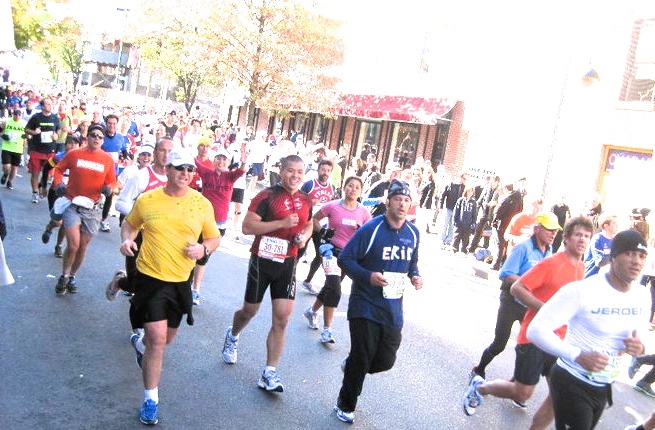
The Everyday Marathon

33987_617299834379_35802270_35121149_6609000_nIf someone had wanted to write about the New York City Marathon they probably would have done it by now. Ideally right after the race or even the next day. Certainly not over a week later- that ship has sailed. What would be the point?

For most of the people running the marathon, the entire point is to complete it. They set out to conquer the unknown and prove to themselves that they can do it. It doesn’t matter what time they finish it, just that they do.

As the sun went down on Marathon Sunday, I stood in the dark next to two complete strangers somewhere near mile 23.5. Together we cheered for another ten thousand complete strangers as they entered Central Park- a scene that marks the final and arguably most mentally challenging act in a performance that runs through each of the city’s five boroughs.

Where earlier the sidelines were packed with crowds three rows deep, now only a small handful of spectators remained. Some keeping vigil for friends or family members yet to pass, others (like myself) cheering for anyone still headed toward the finish line:

A small elderly man whose upper body was bent almost entirely to one side, steadily jogging arm-in-arm with his wife…their smiles beaming through the darkness.

Another gentleman powering through with a look of unshakable determination on his face and a wooden walking cane in his hand.

Multiple runners who had pushed another person in a wheelchair for the entire length of the race but still had the energy to throw a wave toward the dwindling cheering section.

A father walking by whose family had joined him on the course for the final stretch.

The tall, lanky middle-aged man with tousled brown hair who looked me squarely in the eye and simply said “thank you” as he jogged past.

Running can surely be a lonely sport, but the marathon will leave most feeling anything but. Tens of thousands of strangers from all over the world, overcoming pain and weakness to finish this 26.2 mile trek, together. And as this motley crew came trickling in, so too did the genuine spirit of the event.

I can’t say for sure if the words of encouragement that myself or the two strangers next to me shouted made a difference to those runners at all- if any of them carried those words past mile 23 or even past the finish line. I do know, however, that four years ago I carried the words of the kind strangers who cheered me on through every bit of my 26.2 mile trek through NYC. Maybe that’s why I was standing out there in the dark rooting for people I’ll probably never see again. Crossing that finish line was a memorable moment indeed, but when I think back on my experience, the things that come to mind first are the ones that happened during all of the miles and all of the hours that came long before the grandstands.

The most trying part of setting out with grand ambitions is to push past everything that creeps in before you’re actually able to realize them. To finish what you started, without letting darkness, loneliness, or doubt get the best of you.

We’re all part of a marathon in one way or another- and leaning on loved ones, a cane or even strangers to push us forward is all part of the journey. It’s the everyday marathon that connects us all.

Put Your Crop Top On

DSC00020.JPGOne of my dearest friends taught me a very valuable lesson on our run through the park this morning. As I began to list all of my hesitations about publishing my first post, she decided to dispense a few words of wisdom. She also unknowingly gave me a topic for my first post. So here goes:

“You know what?” she began, “When I was running cross country in high school, my teammates and I always thought that only the most elite runners could wear crop tops…so we never wore them,” she explained. Then one day the teammates got to thinking that –gosh darn it– they too were running fast enough and hard enough to don those esteemed crop tops if they wanted to. So, they did just that.

My friend was hoping that I would pick up on the fact that –sans the literal belly baring– this was basically the same story. She went on to remind me that there are a lot of people out there who write and post things on the internet and many of them aren’t all that great. But they do it anyway. They share their lives with the world and bare their most personal details for all to read- the good, the bad and the ugly. “Sometimes you just have to press the button and post it,” she urged. Maybe she had a point. As we reached the spot where we usually split off toward our respective sides of the city, she turned and yelled back to me, “HEY…put your crop top on today!”

Alright then. I’m ready to run.

The things that we carry make us who we are- they are our memories, our lessons learned, our experiences, our people. And for better or worse, we often become them. But it is how we choose to carry these things that determines how they will define us. The stories that follow are intended to be a collection of the most powerful and enduring morals* carried by myself and those around me.

Who knows, maybe you’ll find something here worth taking with you. After all, so much of what we search for in this world –purpose, meaning, inspiration, hope– is already there, if only you can find it.

*mor·al   noun \ˈmȯr-əl, ˈmär-; 3 is mə-ˈral\

: a passage pointing out usually in the conclusion the lesson to be drawn from a story